
Most marketers are playing a guessing game they think is chess.
They spot a pattern: longer posts rank better, video ads cost less, high CTR means a winning ad, and immediately wire up a story about why it works. That story feels like expertise. It gets repeated in agency decks and marketing blogs.
And a lot of the time, it’s completely wrong.
Mistaking correlation for causation is one of the most expensive habits in digital marketing. Not because the patterns are fake: most of them are real. But because understanding why something works is the only way to actually replicate it.
Copy the surface behavior without understanding the mechanism underneath, and you’re just cargo-culting your way through your ad budget.
The good news: once you start seeing this clearly, it changes how you make every decision.
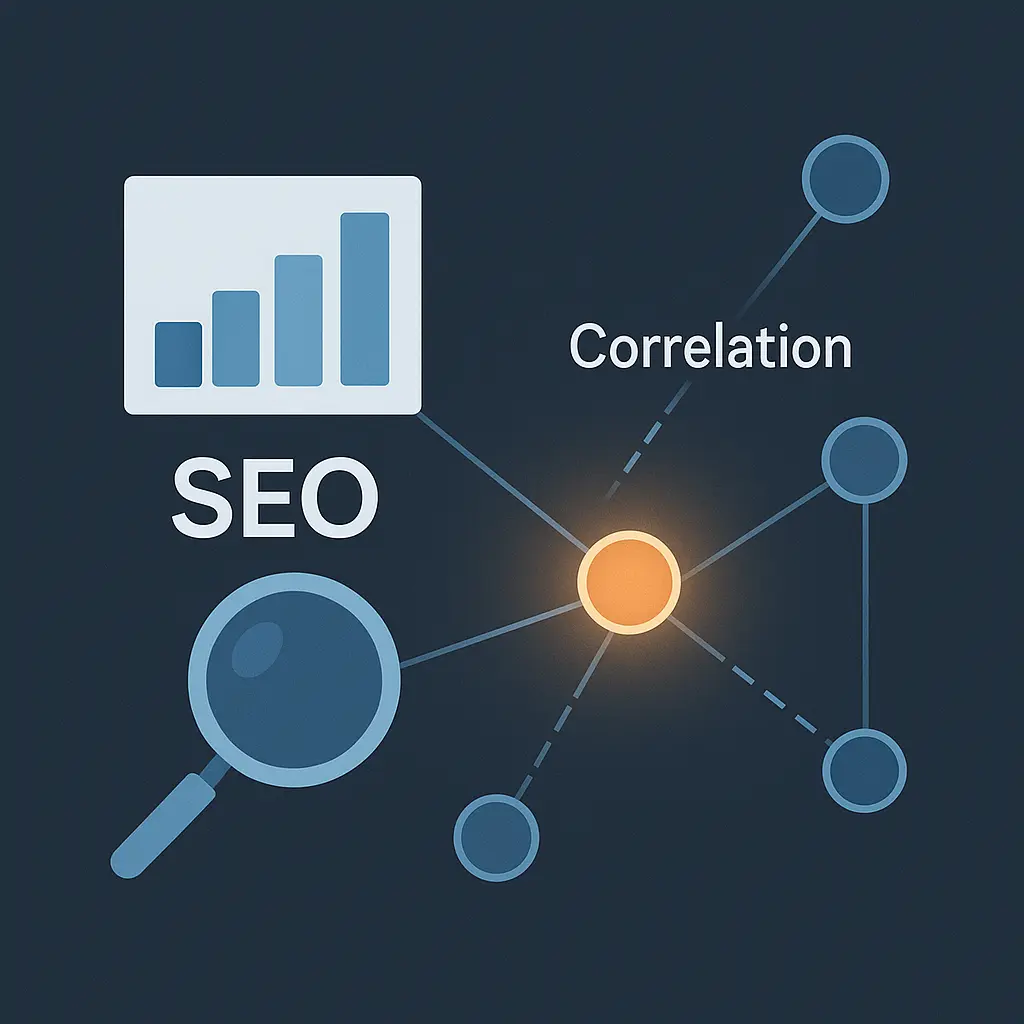
The SEO Side of This Problem
Take the old chestnut that longer blog posts rank better. True? In a lot of cases, yeah.
But not because Google has a word counter running in the background rewarding you for volume. Longer posts tend to rank because they answer more questions, cover a topic more completely, and earn more links from people who find them genuinely useful.
The length is a symptom of thoroughness, not the cause of the ranking. It’s the same reason a well-built content strategy produces results where random publishing doesn’t.
Same story with Domain Authority. Plenty of site owners obsess over their DA score like it’s a grade on a report card. But Google doesn’t use Domain Authority. It’s a Moz metric.
The reason high-DA sites tend to rank well is that they’ve usually built real authority over time: strong backlink profiles, solid content, good technical fundamentals. DA correlates with those things. It doesn’t cause anything.
Refreshing old content is another one. Yes, updating a stale post often gives it a ranking bump.
But if you go back and just change the publish date without improving anything, you’ll probably be disappointed. The lift comes from actually making the content better: tightening the copy, adding fresher data, improving the structure so users stick around longer.
The update is just the vehicle. Better content is the engine.
And exact-match keywords? Everyone’s noticed that pages using a phrase like “Portland personal injury attorney” verbatim tend to show up for that phrase.
But it’s not keyword magic. It’s that using the phrase naturally tends to accompany genuine relevance: real topical depth, intent alignment, user satisfaction. A strong on-page optimization strategy works for exactly that reason: it builds real relevance, not just surface signals.
The keyword signals relevance. It doesn’t manufacture it.
Now Let’s Talk Paid Ads
The same pattern plays out on the paid side, maybe even more dangerously, because the feedback loops are faster and the temptation to act on incomplete data is stronger.
Spending more on Google Ads typically does lead to more conversions, but not because money causes sales.
Bigger budgets usually mean broader reach, more creative testing, faster algorithmic optimization, and better audience coverage. Pour that same budget into a broken funnel or a bad offer, and you’ll just burn through it faster.
The spend enables better execution. It doesn’t replace it.
High click-through rates are another one marketers love to celebrate. A strong CTR feels great: it means people are engaging with your ad.
But a high CTR on a misleading headline just sends curious, unqualified traffic to your landing page. Unless those clicks actually turn into revenue, you’re optimizing for a vanity metric.
That’s why conversion tracking matters so much. CTR matters when it’s connected to qualified intent. On its own, it’s just noise.
Video and display ad campaigns are widely believed to be cheaper, and often they are: lower CPC than static image ads in a lot of placements.
The reason has nothing to do with video being inherently more efficient. Facebook, Instagram, and YouTube prioritize video because their users engage with it longer, which improves their own platform metrics.
You benefit from that prioritization. The format isn’t cheap. The algorithm just rewards it.
Retargeting and lookalike audiences are among the most misunderstood tools in paid social. The technology works by finding people who look like your existing customers, which sounds great, until you realize the entire thing depends on the quality of your seed audience.
A weak or sloppy seed list produces a weak lookalike. The feature is the vehicle. The quality of your customer data is what actually drives performance.
And multi-platform advertising (running campaigns across Google, Meta, YouTube, and beyond) genuinely does lift brand awareness.
But it’s not presence alone doing the work. Consistent messaging across channels creates familiarity and trust over time, which makes people more likely to convert when they’re finally ready.
It’s not ubiquity that works. It’s coherence.
What This Actually Means for Your Marketing
Patterns are useful. Recognizing that something consistently happens before a good result is a reasonable signal worth paying attention to.
But stopping there, assuming the correlation is the full explanation, leads to wasted effort and wasted budget.
The marketers who win over the long haul are the ones who ask a second question: not just “what happened?” but “why did it happen?”
That habit of looking past the surface pattern to the real mechanism underneath is what separates people who react to data from people who understand it.
SEO and paid ads are both full of things that appear to drive results. The real forces behind consistent performance are more complex, more layered, and a lot less obvious than most people want to admit.
Learn to spot the difference, and you’ll make better decisions than most of your competitors, almost by default.


