

If you own a local business and your rankings are not moving, there is a good chance you, or whoever you hired, is running general SEO plays on a local SEO problem. The two are related. They are not the same game.
General SEO is a fight to rank a webpage above every other webpage in the world. Local SEO is a fight to rank inside a specific city, on a specific map, with a specific set of trust signals that general SEO guides barely mention. The plays that win one do not always win the other.
We have been doing local SEO for businesses in Portland and across the country since 1999. The pattern is the same nearly every time. A business gets sold an “SEO package,” the work happens, and six months later they still are not in the map pack. The work was real. It was just aimed at the wrong target.
This guide breaks down the actual difference between local and general SEO, and what local-specific work to do this quarter to start showing up where your customers are searching.
Local Search Has Two Search Engines, Not One
Most general SEO guides skip this part. When someone in Portland types “plumber near me,” Google does not give them one set of results. It gives them two.
The first is the map pack. Three local listings, an interactive map, ratings, hours, a call button. The second is the standard list of organic results below it. These are two separate search engines with two separate ranking algorithms running on the same screen. Your business has to compete in both.
Google Maps listings are powered by your Google Business Profile, your reviews, your categories, and your proximity to the searcher. Organic local listings are powered by traditional on-page SEO, content depth, backlinks, and site authority, with a heavy local intent layer on top.
The shortcut nobody mentions: The map pack sits above the regular search results on most local searches. It is the first thing the searcher sees. If you only optimize your website and ignore your Google Business Profile, you are competing for whatever attention is left after that.
General SEO ignores the map pack because most general SEO is written for businesses that do not have a physical location or service area. Treat it like a sidebar and you will leave most of your potential leads on the table.
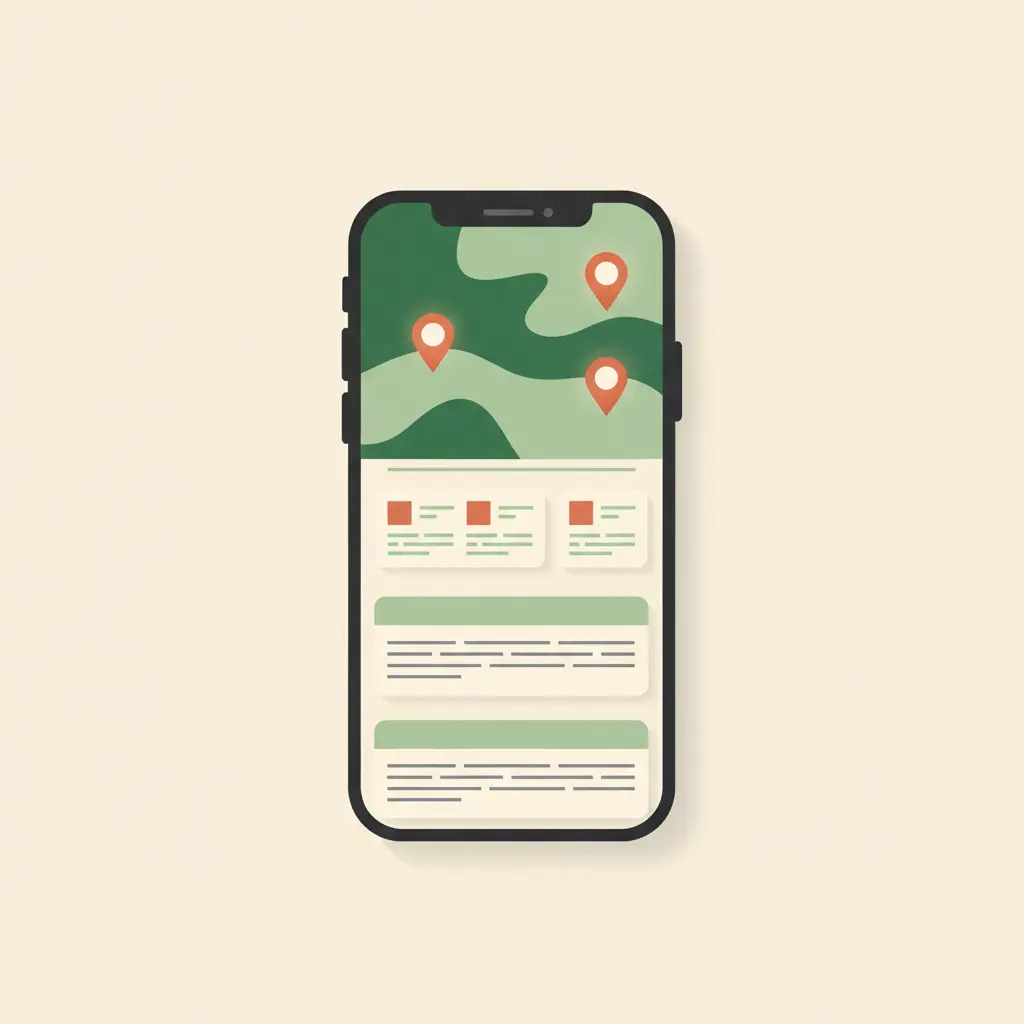 A local search returns two stacked result layers: the map pack on top and the organic listings below.
Why Proximity Is the One Lever You Cannot Pull
This part surprises every business owner we walk through it with. The single biggest factor in whether your map listing appears for a searcher is how close your business address is to where they are physically searching from. That is it. You cannot optimize proximity. You cannot buy your way around it.
This changes the math depending on what kind of business you run.
Storefront Businesses
If customers come to you, like a barber shop, dental practice, or restaurant, proximity is a hard ceiling. You will rank well in the neighborhoods around your address and weakly in the ones a few miles away. No amount of content, backlinks, or schema markup will change that. Your job is to dominate the area you can actually serve.
Service Area Businesses
If you go to the customer, like a plumber, landscaper, or law firm that takes meetings at the client’s office, proximity matters less than the service areas you declare in your Google Business Profile. You have a real shot at ranking across an entire metro, which is exactly why the next levers in this guide matter so much for you.
The mistake is treating both types of business the same. A storefront chasing rankings two cities over is wasting budget. A service area business that only optimizes for the city its office sits in is leaving most of its territory uncovered.
The Four Levers That Actually Move Local Rankings
Across hundreds of local SEO engagements, the same four fields drive most of what is reachable on a Google Business Profile. They are unglamorous and take a few hours to set up properly. In the first 90 days they outperform almost anything else a local business can do.
| Lever | What It Controls | Common Mistake |
|---|---|---|
| Primary Category | Which searches your listing is eligible to appear for | Picking the broadest possible category instead of the most specific accurate one |
| Services | Long-tail visibility for specific service queries | Leaving the services list empty or generic |
| Service Areas | Geographic reach for service area businesses | Spamming every city in the state and getting flagged |
| Reviews | Trust, click-through, and ranking weight | Treating it as a one-time push instead of a steady habit |
Notice what is not on that list. Schema markup. Site speed. Internal linking. Those things matter for your organic local rankings on the website side, and we work on them in every campaign, but they are not what gets you into the three-listing map pack.
If you have not touched your Google Business Profile in a year, start here before anywhere else. There is a deeper walkthrough in our guide to optimizing your Google Business Profile.
Review Velocity Beats Review Count
Most businesses approach Google reviews like a fundraising drive. They blast every past client once, get a burst of reviews, and then go quiet for a year. Local search rewards the opposite pattern.
What Google appears to weigh, based on patterns we have watched across client accounts, is review velocity. A steady stream of new reviews tells the algorithm that the business is still active and still serving customers. A profile with 80 reviews from one month two years ago and nothing since looks dormant, even if the star rating is great.
What a healthy review pattern looks like: Three to ten new reviews per month, every month, with a mix of recent dates visible at the top of your profile. This beats a one-time push of 50 reviews followed by silence every time.
The other piece is the rating itself. We have seen 4.7 to 4.9 averages convert better than a perfect 5.0. Searchers read 5.0 with 30 reviews as suspicious. They read 4.8 with 200 reviews as real. Honest businesses earn the occasional four-star review, and that turns out to be a feature, not a bug.
Build a system that asks every satisfied customer for a review at the moment they are happiest, usually right after the job is complete. Then keep that system running for years, not weeks.
Service Plus City Pages: The Local-Only Play
This is where local SEO and general SEO part ways most sharply. A general SEO strategy might say “build one excellent page for plumbing services and earn backlinks to it.” A local SEO strategy looks at the same business and says “build a focused page for every meaningful combination of service and city you serve.”
Think of it as a matrix. Down one side, the services you offer. Across the top, the cities or neighborhoods you serve. Each cell is a potential page someone could land on after searching for that exact service in that exact place.
 Each cell in the service-by-city matrix is a potential page that ranks for one specific local search.
Done well, this approach captures search intent that a single generic service page never could. Someone searching “emergency plumber Lake Oswego” expects a page that mentions Lake Oswego, addresses the urgency, and proves you actually serve that area. A generic “Plumbing Services” page does none of those.
Done badly, this approach builds 400 near-identical pages that Google flags as thin content and ignores. The line between the two is whether each page has a genuine reason to exist. Original copy about that specific service in that specific area. A photo of an actual project there if you have one. A quote from a customer in that city if you can get one. Without something local on the page, it is just a template, and Google can tell.
For most local businesses, somewhere between 10 and 50 service-area pages is the sweet spot. Build them slowly. Watch which ones earn traffic and calls. Put more into the ones that do. This is the kind of SEO strategy work that compounds over years.
Localized Blog Topics Beat Generic Ones
Blog content for local businesses follows the same principle. A general SEO play targets “best wedding venues.” A local SEO play targets “best wedding venues in Portland.” The first ranks against the entire internet. The second ranks against a handful of local competitors, and brings in readers who are actually in a position to hire you.
The other shift is who you write for. A general blog targets the people who already need your service. A local blog can target the people next to those people. A wedding photographer who writes about local venues, local florists, and local catering options reaches couples planning weddings in their city, even when those couples are not yet thinking about photography. By the time they are, the photographer is already familiar.
This is one of the most underused habits in local marketing. Pick three to five topic areas that sit at the intersection of your service and your geography, then publish on them consistently. A few examples for a Portland law firm:
- Average cost of a personal injury attorney in Portland
- What to do after a car accident in Multnomah County
- How long do personal injury cases take in Oregon
Each of those targets a specific local query with clear search intent and very few sophisticated competitors. That is the local SEO advantage. You are not fighting the world. You are fighting the law firm two blocks over, and most of them are not writing anything at all.
What to Do This Week
If this guide convinced you that your current approach is mismatched to the local game, here are three concrete moves to start with. None of them take more than a few hours, and they outperform almost anything else you could do.
1. Audit Your Google Business Profile
Log in, review your primary category, your services list, your service areas, your business hours, and your photos. Most businesses we audit are using a broader category than they should and have left the services list mostly empty. Both of those are fixable in an afternoon.
2. Set Up a Review Request System
Pick the moment in your customer journey when satisfaction is highest, usually right after the work is delivered, and build a habit of asking for a review at that moment. Email, text, or in person all work. Consistency matters more than the channel.
3. Map Out Your Service Plus City Pages
List your real services down one side of a page and the cities or neighborhoods you actually serve across the top. Circle the combinations that represent meaningful demand. Those are your next 10 to 20 service-area pages, prioritized by what would actually generate revenue.
Local SEO Rewards Local-Specific Work
General SEO advice is everywhere. Most of it is good for the problems it is written for. The trouble is that “rank a webpage globally” and “rank a business locally” are two different problems, and conflating them is the single most common reason local businesses stay invisible in the map pack.
The good news is that the local game is winnable. Your real competition is the handful of other businesses in your service area, and most of them are running on autopilot. Get the four levers right. Build the habit of steady reviews. Put service-specific local pages in front of the searches your customers are actually running. The rankings tend to follow.
If you want a second set of eyes on where your local strategy is and is not working, we will walk through your Google Business Profile, your service area coverage, and the map pack you should be competing in. We will tell you honestly whether the gap is closeable in your current budget.


