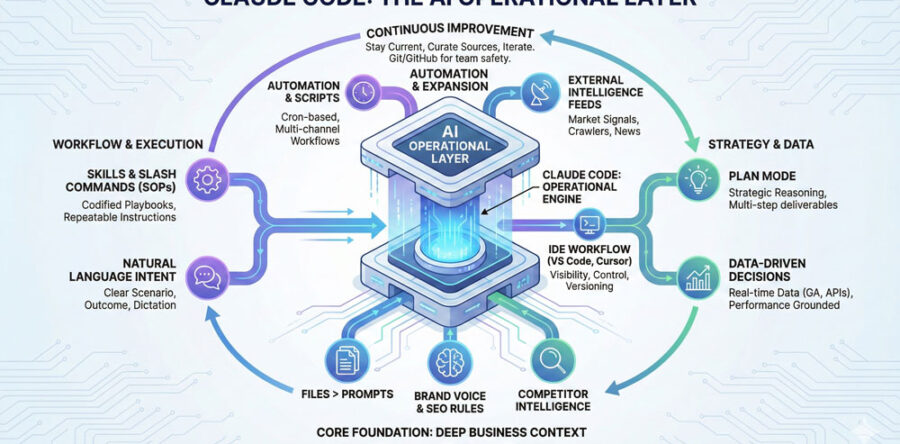
** I had prepared an outline with key insights and points. This article is what Claude Code wrote. It's better than the version Claude wrote without the context system using the same outline and prompt. See what I mean? **
Most people treat AI like a chatbot. They type a question, get an answer, and move on. That works for quick lookups. It does not work for running marketing, operations, or content at scale.
Claude Code is different. It is not a chat window. It is a working environment where AI operates inside your business systems, reads your files, follows your playbooks, and executes multi-step workflows. Think of it less as a tool and more as an operational layer that sits between your strategy and your execution.
Using Claude Code for business is not about asking better questions. It is about building a system. This guide covers how to turn it from a one-off assistant into a repeatable operation that handles real work across marketing, SEO, analytics, and content.
Why Claude Code is an operating system, not a chatbot
Context beats prompt engineering every time
Here is where most people go wrong with AI: they spend hours crafting the perfect prompt.
That approach misses the point entirely. Roughly 75% of AI output quality comes from structured business context, not clever prompts. Context means your brand voice, competitor intelligence, SEO strategy, conversion principles, and product positioning. All documented. All accessible.
The difference is simple. A prompt tells AI what to do right now. Context tells AI who you are, what you stand for, and how you operate. One is disposable. The other compounds.
What context looks like in practice:
- A brand voice document that defines tone, word choice, and messaging pillars
- A competitor analysis that maps positioning and gaps
- SEO guidelines covering keyword rules, structure standards, and search intent requirements
- Conversion optimization principles that inform every page and CTA
- An internal links map that connects content strategically
These files live in your working directory. Claude Code reads them before every task. No re-explaining. No drift. Consistent output, every time.
If you skip this step, no amount of prompt engineering will save you.
Working inside an IDE changes everything
Chat-based AI tools have a ceiling. You type a message, get a response, and copy-paste it somewhere else. There is no file system, no version history, no visibility into what happened between sessions.
Working inside VS Code or Cursor removes those limitations. You see every file Claude Code creates. You see the research briefs, the drafts, the analysis reports. You can review changes, roll back mistakes, and track what was done and when.
For anything beyond a quick question, this matters. Marketing campaigns, content pipelines, SEO audits, and performance reviews all produce artifacts. Those artifacts need to be stored, versioned, and iterable. A chat window does not give you that. A development environment does.
This is not about being technical. It is about having control over your outputs and being able to build on them over time.
Building AI marketing workflows with commands and skills
Skills and commands are SOPs for AI
Every business runs on standard operating procedures, whether they are written down or not. The best teams codify their processes so work gets done consistently regardless of who executes it.
Claude Code handles this through skills and slash commands. These are essentially codified marketing playbooks. Instead of writing a 500-word prompt every time you need a blog post, you run a command. Instead of re-explaining your SEO process, the command already knows the steps.
This mirrors how you would train a junior hire. You would not give them a blank page and say "figure it out." You would hand them a checklist, a framework, and examples of good work. Skills and commands do exactly that for AI.
What this looks like:
- A
/researchcommand that runs keyword analysis, competitor research, and generates a structured brief - A
/writecommand that creates a full article following your brand voice, SEO rules, and content structure - An
/optimizecommand that runs a final SEO polish pass before publishing - A
/performance-reviewcommand that pulls analytics data and surfaces content priorities
Each command encapsulates hours of process design into a single, repeatable instruction. That is where the leverage comes from.
Natural language still matters
Good context and strong commands do not eliminate the need for clear communication. Garbage in, garbage out still applies.
When you give Claude Code a task, clarity of intent matters more than prompt formatting. What is the scenario? Who is the audience? What stage of the buyer journey are they in? What outcome do you need?
A clear, conversational brief often outperforms a "perfectly engineered" prompt full of brackets and variables. Dictation works. Plain language works. What does not work is vague instructions with no direction.
Be specific about what you want. Be clear about who it is for. Describe the desired outcome. The context files handle everything else.
Plan mode is for high-stakes work
Not every task needs a plan. Quick edits, simple lookups, and routine commands run fine without one.
But for complex, multi-step work, plan mode changes the quality of output dramatically. It forces Claude Code to research before acting, reason through the approach, and ask clarifying questions before committing to a direction.
Think of it like briefing a senior strategist. You would not hand them a campaign and say "just go." You would expect them to come back with questions, an outline, and a recommended approach before execution starts.
Plan mode works the same way. It is ideal for:
- Multi-channel campaign planning
- Product launch strategies
- Content systems that span dozens of pages
- Complex SEO content strategy that requires research and prioritization
The extra time spent in planning saves hours of rework downstream.
Data-driven AI operations for your business
AI decisions should be driven by real data
AI is useful when it generates ideas. It becomes powerful when those ideas are grounded in actual performance data.
Pulling live data from Google Analytics, Google Search Console, SEO APIs, or product metrics into Claude Code changes the dynamic completely. Instead of guessing which content to prioritize, you know. Instead of assuming what keywords matter, you see the numbers.
This is a force multiplier. Data-driven AI can identify:
- Which pages are losing rankings and need updates
- Which keywords have high volume but low competition
- Where conversion rates are dropping
- Which content topics have the highest organic growth potential
When AI analyzes reality instead of assumptions, prioritization gets smarter and iteration gets faster. That is how you move from "using AI" to "operating with AI."
For businesses already tracking performance, connecting those data sources to Claude Code means every recommendation is grounded in what is actually happening, not what you assume is happening. This is what separates AI as a novelty from AI as an operational tool for growth.
Automation creates leverage most teams never reach
The real gap between teams that use AI and teams that are built on AI is automation.
Scheduling reports, analyses, and workflows removes the mental overhead of remembering what needs to happen and when. Cron-based automation ensures that performance insights are ready before your Monday meeting, not assembled during it.
This shifts the role of humans up the value chain. Instead of pulling data and formatting reports, you review insights and make decisions. Instead of running the same analysis every week, you focus on the strategic questions that analysis surfaces.
Practical examples:
- Automated weekly SEO performance reports delivered before team standups
- Scheduled content audits that flag pages needing updates
- Triggered workflows that generate social content from published blog posts
- Automated competitor monitoring that surfaces new opportunities
Each of these replaces repetitive manual work with a durable, self-running system.
External intelligence expands your advantage
Your business does not operate in a vacuum. Markets shift. Competitors launch new campaigns. Industry conversations happen on Reddit, YouTube, LinkedIn, and Twitter.
Monitoring those signals manually is unsustainable. Automating them is a competitive advantage.
Crawlers, scrapers, news monitors, and research tools can feed opportunity signals directly into your Claude Code workspace. When a competitor publishes a new landing page, you know about it. When a trending topic in your industry starts gaining search volume, it shows up in your queue.
More inputs lead to better strategic outputs. The businesses that see signals first act on them first.
Scaling Claude Code across your team
You do not have to do everything inside one tool
There is a temptation to force every task into a single platform. That is ideological purity, not good strategy.
Claude Code is strong for content operations, SEO execution, marketing automation, and analytical workflows. But it is not a CRM. It is not a design tool. It is not a replacement for every piece of software you use.
The goal is outcomes. If a lead research platform fills a gap faster than building a custom script, use it. If a dedicated analytics dashboard gives your team better visibility, keep it.
Complement Claude Code with the tools that make your overall system stronger. Focus on results, not on doing everything in one place.
Version control is non-negotiable for teams
When one person uses AI, the files live on their machine and the process lives in their head. That does not scale.
Git and GitHub turn AI workflows into shared, improvable assets. Every research brief, every draft, every optimization pass gets tracked. Team members can review changes, suggest improvements, and roll back mistakes without risk.
This is how AI systems grow beyond a single founder. It creates accountability, collaboration, and a clear history of what was done and why. Version control is not optional overhead. It is the infrastructure that makes AI workflows safe and scalable for teams.
Scripts unlock compounding automation
Individual commands are useful. Scripts that chain commands together are transformative.
A script connects triggers, prompts, outputs, and destinations into a single automated workflow. One action, like publishing a blog post, can automatically generate a LinkedIn post, a Twitter thread, an email summary, and an internal update.
This replaces manual content repurposing with a durable, repeatable system. The effort goes in once. The output compounds across every channel.
The more scripts you build, the more leverage you create. Each new workflow removes one more piece of repetitive work from your team's plate. Over time, that compounds into a significant operational advantage.
Staying competitive with AI systems
AI evolves faster than any other technology category. What worked three months ago may already be outdated. New capabilities launch weekly. New patterns emerge from practitioners sharing what works.
Passive learning is not enough. You need curated sources that deliver signal without noise. Consistent, focused exposure to what is changing and what is working beats occasional deep dives that leave you overwhelmed.
Follow a small number of practitioners who build with these tools daily. Watch for capability announcements that unlock new workflows. Test new features in your existing systems before they become standard practice.
The teams that stay current build advantages that compound. The teams that wait play catch-up indefinitely. Anthropic's Claude Code documentation is a good starting point for understanding what is possible today.
Start building your AI operating system for business
AI is not a replacement for your team. It is leverage for your team.
The businesses that treat Claude Code as a system, not a toy, build compounding advantages. They ship faster. They operate leaner. They make better decisions because those decisions are grounded in data, guided by context, and executed through tested workflows.
Building that system takes effort upfront. You need to document your context, design your commands, connect your data sources, and automate your workflows. But that investment pays dividends every single day after it is in place.
The gap between businesses that use Claude Code for business and those that wait will only grow. The fundamentals are clear: context over prompts, systems over sessions, data over assumptions, and automation over manual work.
Start building the system. The returns compound from day one.
Ready to build systems that drive real growth? Schedule a strategy call and let's talk about how to turn your marketing into a repeatable, scalable operation.