** I had prepared an outline with key insights and points. This article is what Claude wrote. It's good, but now check out what Claude code with context wrote using the same outline and prompt. See what I mean? **
Most people are using AI wrong.
They're treating it like a magic typewriter—firing off prompts, copying outputs, and wondering why the results feel inconsistent. They're stuck in the "better prompts" trap, endlessly tweaking wording instead of building systems that compound.
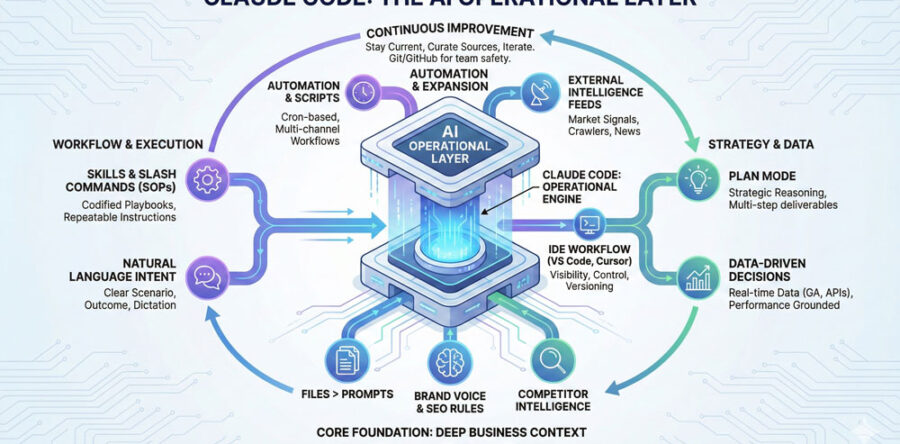
Claude Code isn't just another AI tool. It's an operational layer that can run parts of your business. Think of it as a junior operator, marketer, analyst, and co-founder rolled into one—if you set it up correctly.
Here's what that actually looks like in practice.
The Real Problem: Prompts vs. Systems
Prompt engineering is overrated.
Not useless—overrated. The obsession with perfect prompts misses the point entirely. You wouldn't hire a talented junior marketer and give them nothing but vague instructions and zero context. Yet that's exactly how most people use AI.
The breakthrough happens when you stop thinking about prompts and start thinking about systems. When you treat AI like a trained team member who needs onboarding, documentation, and repeatable processes.
Context Is 75% of the Game
Here's the uncomfortable truth: 75% of your success with AI comes from deep, structured business context, not clever prompting.
Context should live in files, not in your head or scattered across one-off chats. This means maintaining actual documents:
- Your brand voice and positioning
- Competitor analysis and differentiation
- SEO rules and content guidelines
- CRO principles and testing frameworks
- Ideal Client Profiles
- Real examples of what good looks like
Most people fail here. They skip the foundation and wonder why their outputs feel generic. They're asking a stranger to write like they know your business, your customers, your market.
Feed Claude Code the same context you'd give a new hire, and watch the quality transform overnight.
Why Your Working Environment Actually Matters
Chat interfaces are fine for quick questions. For serious work? They're a liability.
Working inside an IDE like VS Code or Cursor gives you visibility, control, and versioning. You can see your files, track your plans, audit your outputs, and review reports—all in one place.
This isn't about being technical. It's about having the right workspace for the job. You wouldn't run your business out of text messages. Don't run your AI operations out of a chat window.
Skills and Commands Are Your AI SOPs
Skills and slash commands are essentially codified marketing playbooks. They replace long, error-prone prompts with short, repeatable instructions.
This is exactly how you'd train a junior hire: with checklists, frameworks, and documented processes. The difference is that AI never forgets the playbook, never has an off day, and executes consistently every single time.
Your competitive advantage isn't having access to AI. It's having better SOPs built into your AI workflows.
Natural Language Still Wins (When Used Right)
Even with perfect context and commands, garbage in still equals garbage out.
The difference is clarity. Not formatting, not jargon—clarity about:
- Your intent
- The scenario or situation
- The user journey
- The desired outcome
Dictation plus clarity often beats "perfectly engineered" prompts. Talk to Claude Code like you'd brief a smart colleague. Be specific about what success looks like.
Plan Mode: Your Secret Weapon for Complex Work
Plan mode forces Claude Code to research, reason, and ask clarifying questions before executing. This dramatically improves outcomes for multi-step deliverables like campaigns, launches, or complete systems.
Think of it like briefing a senior strategist before they start work. The upfront investment in planning saves hours of iteration and produces higher-quality results.
Use plan mode when the stakes are high and the work is complex. Use quick execution for everything else.
Ground AI in Real Data, Not Assumptions
AI becomes exponentially more useful when it's analyzing reality instead of guessing.
Pull live data from Google Analytics, Search Console, SEO APIs, or your product metrics. Let Claude Code work with actual performance numbers, conversion rates, and user behavior.
This enables smarter prioritization, faster iteration, and recommendations that actually move the needle. Assumptions are cheap. Data-driven insights are leverage.
Automation Creates Leverage Most Teams Never Reach
Here's where it gets interesting: scheduling reports, analyses, and workflows removes mental overhead entirely.
Set up cron-based automation so insights are ready before meetings, not after. Claude Code can prepare competitive analyses overnight, generate performance reports every Monday morning, or monitor key metrics and alert you to anomalies.
This shifts humans up the value chain to judgment and strategy. You stop doing the work and start directing it.
Turn External Intelligence Into Opportunity Signals
Your competitors are publishing. Your market is evolving. Trends are emerging on YouTube, Reddit, Twitter, and industry publications.
Most businesses react to these signals manually, slowly, or not at all. Smart operators automate the monitoring:
- Crawlers watching competitor content
- Scrapers pulling pricing or positioning changes
- News monitors flagging industry developments
- Research tools identifying emerging opportunities
Feed these inputs into Claude Code and let it turn signal into actionable opportunity reports.
More inputs equals better strategic outputs.
Tool Stacking Without Dogma
You don't have to do everything inside Claude Code.
Complementary tools can plug gaps quickly. Lead research platforms, specialized analytics, design tools—use whatever gets results fastest.
The goal is outcomes, not ideological purity around one tool. Build systems that work, not systems that look impressive.
Version Control Makes AI Workflows Team-Safe
Git and GitHub aren't just for developers anymore. They turn AI workflows into shared, improvable assets.
Rollbacks let you undo mistakes instantly. Collaboration means multiple team members can iterate on the same systems. Version history creates accountability and learning.
This is how AI systems scale beyond a single founder. Without version control, you're building on sand.
Scripts Turn Single Actions Into Multi-Channel Workflows
Scripts connect triggers, prompts, outputs, and destinations into automated chains.
One action—like publishing a YouTube video—can automatically create:
- Twitter threads
- LinkedIn posts
- Email newsletter content
- Blog article drafts
- Short-form video scripts
This replaces repetitive manual work with durable workflows that compound over time. You create once and distribute everywhere, automatically.
Staying Current Isn't Optional Anymore
AI evolves too fast for passive learning. What worked three months ago is already outdated.
But you don't need to read everything. Curated sources matter more than volume. Consistent exposure beats occasional deep dives.
Find the signal sources that matter for your business and build a system to process them. This is a competitive requirement now, not a hobby.
The Bottom Line: Early System Builders Win
AI won't replace humans. But humans who build AI systems will replace humans who don't.
The opportunity right now is building leverage that compounds. Not better outputs—better systems that produce better outputs automatically, repeatedly, at scale.
Claude Code is the operating system. Your context, workflows, and automation are the competitive moat.
Start treating AI like infrastructure instead of a tool. Document your context. Build reusable commands. Automate your intelligence gathering. Chain your workflows.
The businesses winning in 12 months won't be the ones with the best prompts. They'll be the ones with the best systems.
And those systems are being built right now.
Ready to build systems that drive real growth? Schedule a strategy call and let's talk about how to turn your marketing into a repeatable, scalable operation.